Tag: Black People

  • The “Why” Inside Dapper Black Box

    The “Why” Inside Dapper Black Box

    The subscription service business platform is a growing phenomenon. It adheres to the shoppers desire of convenience and cost-efficiency. Hear from Dapper Black Box Founder, Aaron Barnes, as he breaks down the “Why” inside the box as their company also adheres to some shoppers third desire, consciousness.

    The first thing many of us do when we decide to buy black is search for black-owned directories online. Poring over google search engine pages, Facebook groups, Tumblr threads, and the like, you can come across dozens of directories without a lot of overlap.

    That’s a big problem. It’s such a big problem that I thought I wanted to fix it at first.

    Encouraging investment

    But the more I thought about what I really wanted for a business that I created, Dapper Black Box’s mission emerged. Dapper Black Box (DBB) exists to encourage investment into black-owned businesses (BOBs).

    Though business directories certainly do this, I wanted to take a more direct route.

    Championing collective energy

    One critique I have of black-owned directories was that it they make it difficult for consumers to choose between options. There are few signals to the consumer that any business is better positioned to meet his needs. At the same time, it’s in every independent business’ interest to self-promote, but when everyone is saying, “Look at me! Buy from me!” it’s hard to choose who to buy from. I thought DBB could serve as a third-party entity focused on championing the collective energy that each individual business puts out into the digital marketplace. In other words, DBB says, “Look at all of this amazing work that BOBs are doing in this space!”

    Selling an idea

    It was when I focused on the idea of encouraging investment into black businesses that creating DBB to be a subscription service began to make sense. Not only are subscription services an easy-to-manage business model for my day-career, but they are also an excellent vehicle for advancing our mission.

    Again, DBB exists to encourage investment. Using a subscription business model allows us to encourage consistent investment by recycling the recurring payments back into black-owned businesses. We go beyond pointing to worthy BOBs and make it easy to support them by curating 4–5 items from different brands each month.

    Continuing to meet our audience’s needs

    Now that we’ve sent over 2,500 subscriptions in less than 2 years, I’m convinced that we’re beginning to meet a need in the market. Our goals over the next phase of DBB’s growth are to continue to meet our target audience’s needs by expanding what it means to be dapper and celebrating blackness more generally.

    We’re addressing the first need by connecting BOBs that don’t clearly fit a traditional “dapper” definition with our partner, Impact Service Promotions (sp?). ISP is a BOB within my family in-law that helps supply businesses with thousands of promotional materials. We have partnered with ISP to supply developing BOBs with promotional materials that can help get the word out about their businesses.
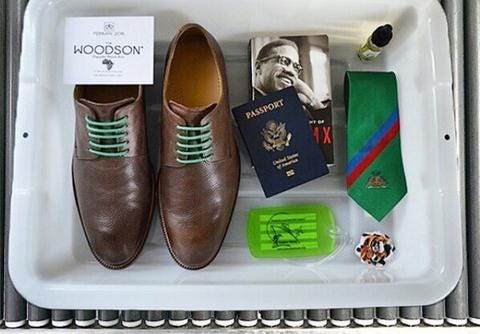
    I’m especially excited about how we’re addressing the second need. DBB subscribers/followers know that we name each month’s curation after an influential black man (e.g., March’s DBB was named in honor of Clarence Avant). Up until the middle of 2016, we did not provide much information about the DBB namesake. Now, however, we’re digitally chronicling information about each DBB namesake through our YouTube series, “The Bigger Picture.”

    I’m always happy to discuss ideas about how DBB can continue to meet your needs. Please do not hesitate to contact me directly at aaron@dapperblackbox.com so we can chat!

    This article was originally published in Magnepels’ Blog on 4/6/17.

  • What Counts as Buying Black?

    I made a personal pledge a few years ago to spend more money with black-owned businesses. As I’ve traveled along this road, I’ve created a pretty cool subscription company and discovered several new brands to which I feel a genuine connection (I love this card game!).

    One question that has annoyed me on this journey is deciphering what counts as “buying black.”

    Let’s go ahead and account for the obvious. When you purchase a product or service from a company owned by a singular black person or group of black people (e.g., a family), I think everyone would agree that this is “buying black.”

    Where it begins to get tricky for me, is when there are several owners and one (or more) of them is black (e.g., KK&Jay). I’ve come across a significant number of quality businesses with partnership ownership structures where one of the owners was black, but does this count?

    If you answered yes to this, consider the following: wealthy blacks (read: celebrities) who invest in companies are technically part owners in the companies they fund. (Think Kobe Bryant and Body Armor or Kevin Hart and Tommy John.) Is it fair to call purchasing these goods as “buying black?”

    Continuing this line of thinking, several black people are technically “owners” of many companies because of their investments into public companies on the stock exchange. Does it count to call buying from these publicly-owned companies, “buying black?”

    Let’s not forget one of the primary reasons “buy black” became an economic rallying cry. White-owned companies weren’t serving or employing black people for a long time.

    Things have changed somewhat since then. Black people are a significant market segment for several brands (e.g., Black and Mild of Altria) and a useful recruitment pool among numerous mainstream firms. Is it appropriate to call it “buying black” when we purchase from companies that serve and employ black people?

    Have you found yourself thinking about these things? What counts as buying black for you?

    If you’re not black, what causes are you inclined to support with your purchases? What is the rubric that you use to determine whether a company actually meets your criteria?

  • The Bigger Picture Series [VIDEO]

    The Bigger Picture Series [VIDEO]

    I’ll get right to the chase. I’m using my subscription business to gain experience in front of the camera. Videos are a popular way to engage consumers and strengthen brand concepts. In addition, I will undoubtedly use video as a way to engage my “consumers” in the classroom.


    My plan is to use The Bigger Picture series to increase the associations between Dapper Black Box and ideas such as entrepreneurship, innovation, and sustainability.

    Check out the first video below and be critical!

  • Why I Can’t Study Race Related Consumer Issues

    Why I Can’t Study Race Related Consumer Issues

    I spent a short amount of time (9 days, 3,000+ words) researching consumer issues related to the recent killings of black Americans at the hands of law enforcement. It was my way of redirecting some of the hurt and anger I was feeling into something constructive. Since then, I’ve stopped pursuing that idea and I don’t think I will pick it—or ideas like it—up again.

    There are many elements that comprise earnest scientific pursuit. Two of the most important are bias and feedback. Both of these are problematic as it pertains to my study of race-related consumer issues.

    It is best to check your biases and lenses at the door. Carrying and ignoring a bias can lead to frustration, misinterpretation, and ultimately, waste your time. Bias is such an enemy to science that research methods are constantly improving in an attempt to account for, control, or remove it from scientific inquiry.

    One of my greatest biases is related to blackness. My life’s journey would have been completely different had I been born a different skin color. My blackness has colored each and every life event. Some could say that every failure and every success has been because of or in spite of my blackness. I’m not writing today to debate that.

    black-america

    Feedback is critical to scientific progression. Criticism from various audiences helps our work tremendously. Without it, the research that we publish would not be as refined nor as impactful as it could be. I am still learning to appreciate the value of feedback from colleagues because it can be difficult to face criticism when you have invested so much into your work.

    However, the recent murders of two black citizens and 5 police officers confirmed that studying race related consumer issues would be too difficult for me. I would struggle to remove my emotional bias and inherent personal conflict from the scientific inquiry. I would also struggle to deal with criticism about the work because of my emotional attachment to it.

    Granted, I have biases and emotional attachment to my current projects, but my biases and attachment to research related to race issues would be much stronger. Yes, I am sensitive to criticism now, but I am also able to face that sensitivity and appreciate the feedback that I receive. Yet, as long as black bodies continue to be killed without punishment, I doubt that I would be so appreciative of feedback that challenges any element of my race-related research.

    Just look at how ABC News responds to the President of the United States’ live reaction to recent events.

    I will do something, though. Part of what I am already doing manifests itself in my subscription business, Dapper Black Box. I believe that collective economics is an excellent tool to improve the well-being of black Americans. Admittedly, it is not an immediate solution nor is it specific to the issue of police brutality. Help me find a useful way to redirect my frustration and energy for something that can improve this serious problem.


  • 3 Key Themes from Ta-Nehisi Coates’ “Between the World and Me”

    3 Key Themes from Ta-Nehisi Coates’ “Between the World and Me”

    Every now and then, an author emerges as one of the voices of a generation. It’s my personal opinion that Ta-Nehisi Coates is one of our voices. As a national correspondent for the Atlantic, Coates regularly probes issues regarding cultural, social, and political issues.

    In his book, “Between the World and Me,” Coates elaborates on all three issues as the relate to the Black American male existence in an open letter to his teenage son. When I first learned that the book was a letter to Coates’ son, I thought that the ‘World’ referred to both the literal world in which Coates lives and his son.

    I felt that Coates was sharing his take of the world with his ‘world.’ Reading BTWAM in this way made the content that much more powerful. Although there are other more thorough pieces on BTWAM elsewhere on the net (here, here, or here), I thought I’d share my reactions to 3 key themes Coates employs throughout the book: the body, the dream, and the whites.  (more…)