
Author: aaronjbarnes

  • Best U.S. Cities for Black Entrepreneurs: People vs Numbers

    Best U.S. Cities for Black Entrepreneurs: People vs Numbers

    A great historical perspective on black business in the U.S.
    A great historical perspective on black business in the U.S.

    One of the most important decisions about starting a business is deciding where to set up shop. Although many businesses, including my own, have taken to the web to forgo this decision, many businesses still need to resolve this critical issue. For black entrepreneurs, it is equally important to ensure that their business location is also amenable to their lifestyle as African Americans. By this, I mean that the concerns of racial prejudice and discrimination often loom large in the minds of black entrepreneurs. These issues can not only affect their businesses, but their entire way of life.

    Given this dilemma, where is the best place for black entrepreneurs to start a business?

    If you type that question into google, 10+ pages of results emerge, each with different results. As a scholar, I’ve been trained to seek out several sources to build an argument, so I looked at many of the search results to see where the similarities and differences arose.

    Three of the most prominent and cited databases were from of Thumbtack, Nerd Wallet, and Good Call. Maybe unsurprisingly, there was little agreement on the top 10 cities for black entrepreneurs in 2015 among these outlets.  Only one metropolitan area made the top 10 list on each database: Raleigh-Durham, NC.

    Raleigh1

    Without a doubt, the differences in the methods used to calculate the top 10 lists is what created the incongruity among the databases. One major difference in the methods is the reliance on primary vs. secondary data. Primary data is usually collected by the researcher for a specific purpose; examples include surveys, interviews, and behavioral experiments if you really want to get fancy. Although more specific than secondary data, primary data is relatively more expensive to collect. Secondary data, on the other hand, is usually collected by a third party and tends to be more general. Big data usually falls under the category of secondary data.

    My personal research tends to use primary research because I like to hear from and observe actual people and draw my inferences from their stories/behaviors. It was interesting that of the three major databases, only Thumbtack used primary data to generate their list. They surveyed over 1,600 actual black entrepreneurs across the U.S. and used their insights to create their top 10 cities.

    Yes, big data similar to the data used by Nerd Wallet and Good Call can give us access to larger pools of information that are extremely useful, but sometimes I wonder if we might lose some of the insight that we can learn from talking to people at the heart of the issues we study. Really expert researchers bring together a mix of primary and secondary data to generate impactful insights with wide applicability. Maybe someone will read this post and be inspired to use mixed methods to make the 2016 list of the best cities for black entrepreneurs.

    Did your city make the list on either database? Click the links below to find out!
    Thumbtack | Nerd Wallet | Good Call | Google search

  • The Psychology Behind Luxury at the Airport [AUDIO]

    I’m trying something new with these audio recordings to supplement my blog posts. Maybe the pattern will catch on. Stay tuned and let me know what you think!

    For this week’s piece, I invited my wife and travel consultant extraordinaire, Lauren-Ashley to offer some practitioner insight to my initial thoughts about luxury brands at the airport.

    LISTEN IN:
    [audio-clammr mp3=”http://www.aaronjbarnes.me/wp-content/uploads/2016/05/Luxury-at-the-Aiprot.mp3″]


    Read the full article.

  • The Psychology Behind Buying Luxury at the Airport

    The Psychology Behind Buying Luxury at the Airport

    Listen in:
    [audio-clammr mp3=”http://www.aaronjbarnes.me/wp-content/uploads/2016/05/Luxury-at-the-Aiprot.mp3″]


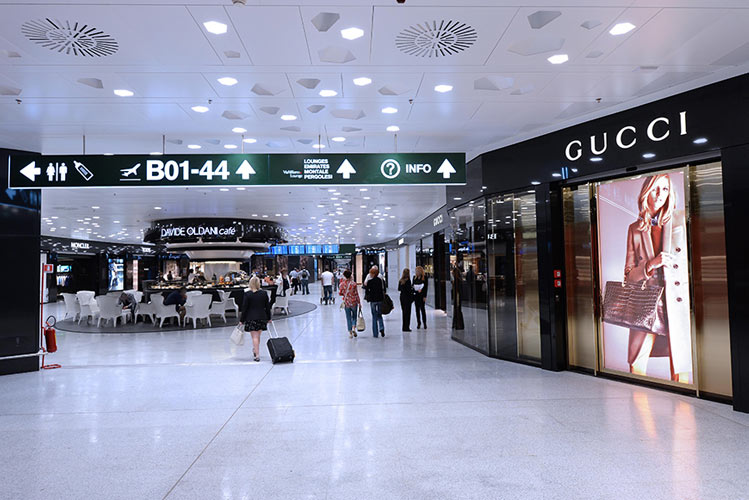
    Each year consumers spend billions of dollars on luxury products—relatively expensive products that provide increased prestige without providing additional utilitarian value. If you’ve been on a trip out of the country or at least flown in an international airport, you probably have noticed the increase in luxury retailers in the shopping area.

    Several airports around the world have recently begun to seek out luxury retailers to include in their international terminals, including San Francisco, London, Hamad in Qatar, and Dallas/Fort Worth International. A recent post in The Guardian attributed the increase in luxury airport sales to new wealthy travelers, but I have a psychological hunch as to why luxury retailers have seen so much success at the runway.

    Why would an American couple be more likely to buy a luxury bottle of wine when traveling to Iceland as opposed to Boston?

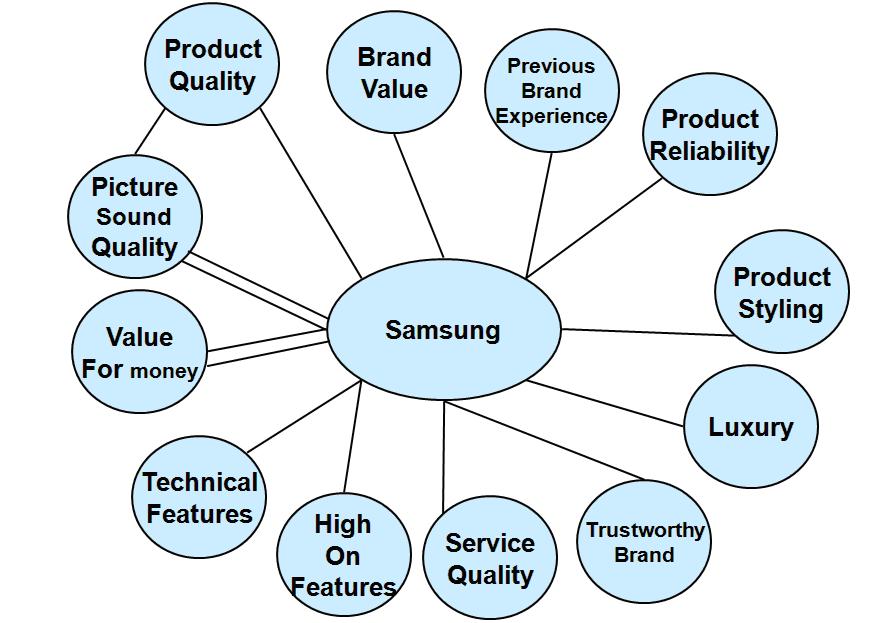
    My hunch stems from the difference in brand concept between luxury and non-luxury goods. Brand concepts are just the unique associations (e.g., high status) that typically emerge from a particular combination of product features (e.g., high price, expensive-looking design, etc.) and a firm’s attempts to create meanings from these combinations (e.g., “the ultimate driving machine” by BMW).

    samsung
    A brand concept map for Samsung

    Luxury goods tend to have brand concepts made up of more abstract associations than non-luxury goods. For instance, it’s more likely for consumers to think of “decadent” and “indulgent” when they see Godiva chocolate as opposed to Hershey’s.

    chocolate-ad-two

    Luxury brands’ abstract concepts allow consumers to perceive greater fit between them and brand extensions into product categories that are much different from the original product category (see Park, Milberg, and Lawson 1991). As an example, it is probably easier to image a Godiva brand of coffee than a Hershey’s brew. In other words, a luxury brand’s abstract associations allow it to transcend product categories.

    When we travel across international borders, we similarly transcend cultures, timezones, and comfort zones. It’s much easier to describe an international trip in terms of its abstract associations (e.g., an opportunity to see the world) and a domestic trip in more concrete terms (e.g., to visit family). I argue that the similarity between brand concepts that transcend product categories and trips that traverse international borders increases our desire for luxury goods. This is because luxury brands benefit from the fact that consumers are literally crossing into foreign territories. This act produces a sort of fluency—or easy psychological processing—for consumers who are presented with luxury options.

    Do you buy my argument? Why else do you think people might purchase more luxury goods when traveling internationally vs. domestically?

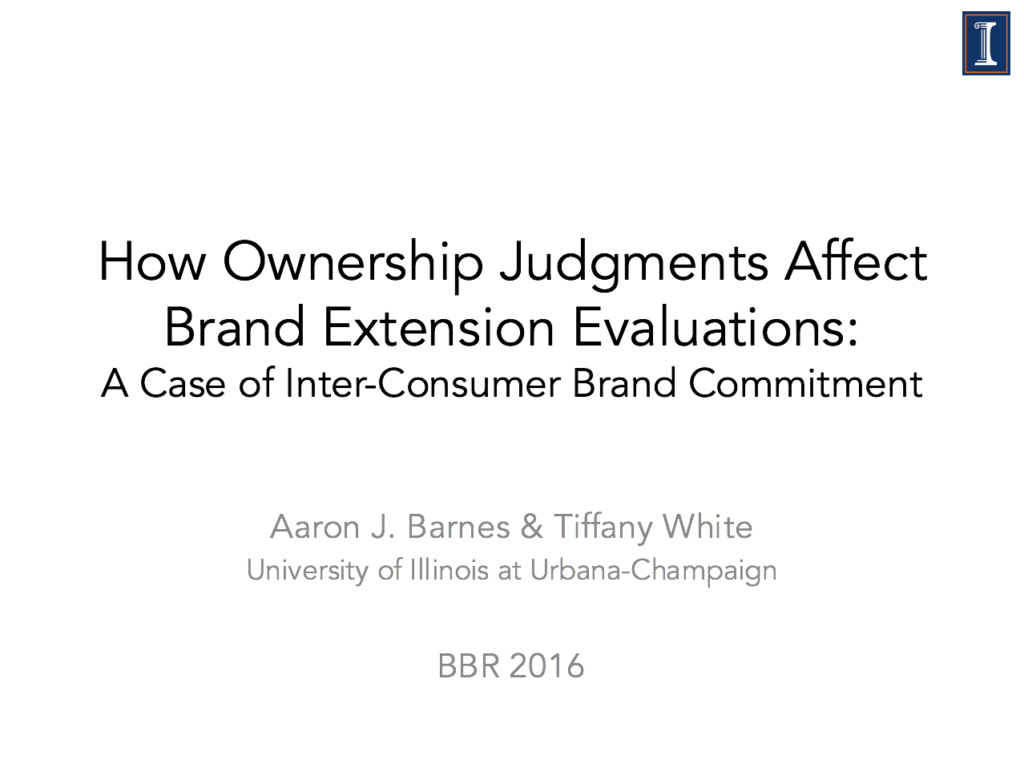
  • How Ownership Judgments Affect Brand Extension Evaluations – Paper Presented at BBR Toronto

    How Ownership Judgments Affect Brand Extension Evaluations – Paper Presented at BBR Toronto

    Recent trends in the marketplace have increased the ability for consumers to access branded goods and services without owning them. This research argues that extending brands into access-based consumption spaces can lead to disparity in inter-consumer brand commitment, which affects user imagery and brand extension evaluation for the firm’s most loyal consumers.

    Read the abstract.

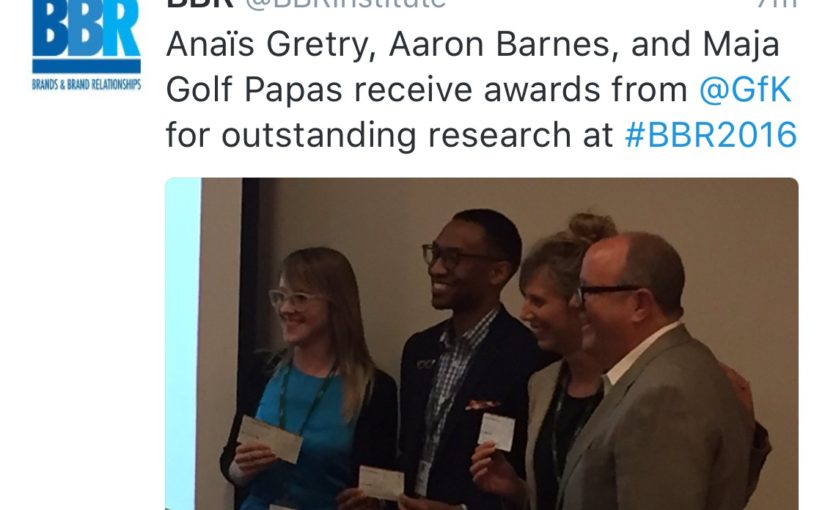
    This research was selected as one of the three Best Papers of the 2016 Brands and Brand Relationship Conference!

    bbr_first_slide

  • How to Prepare for a Presentation

    How to Prepare for a Presentation

    So you’ve got an important presentation coming up in a few days? Here are a couple of tips that I’ve accumulated over the years that have helped me sharpen my public speaking performance. In fact, I am using these tips to prepare for my talk at the Brands and Brand Relationship Conference in Toronto.

    START WITH your audience

    As a marketing scholar, I can’t overemphasize the importance of knowing your audience and catering your talk to them. A conversation about the same spaghetti is bound to be different if you have deliver it to a group of toddlers vs. your wife. I try to think about what the audience already knows and how my talk either aligns with or challenges that assumed knowledge.

    Write it all out

    This part can be tedious, but it has helped me on several occasions. Write out as much as you can stand of your presentation as you would actually say it. This has helped me organize the flow of my presentation beyond that of an outline and get everything I think I need to say on paper. However, I’m sure that as I improve, I will be able to shed this habit.

    Whether you write it all out or not, throw away or hide that write-up. I don’t like to come across like I’m regurgitating a speech that I memorized and I don’t want to be tied to the words that I wrote down just in case a current event or impromptu metaphor helps to illuminate a point.

    Practice extemporaneously

    This tip builds on the previous point. After you’ve written out all that you feel you need to say and hidden that document from your view, practice with only an outline of your major points. Challenge yourself to explain your ideas in different ways every time you practice. This has helped my ability to answer questions because I’ve wrestled with my own ideas from several angles.

    When practicing, try and get feedback from people you trust. It is very likely that you will overlook some hole in your logic or a miss a step in your argument that the audience will not be able to fill. Allow a trusted friend or colleague the opportunity to critique your presentation and help improve it.

    Hype yourself up right before

    After practicing and revising your talk, it’s common to feel a little anxiety toward presenting your ideas to others. That’s why right before I present, I like to find some time to boost my adrenaline and endorphins. Here are some examples of how I hype myself up:

    • Dance in front of a mirror to a favorite song
    • Mimic an NBA-style or heavyweight boxing championship introduction
    • Look up recent news or jokes that relate to my presentation and figure out how to insert it into the talk
    The delivery

    When delivering your talk, be yourself and leverage the unique characteristics that make you, you. If you like anime, find a way to tie your talk into Dragonball Z references (and explain them generally for those who may be unfamiliar).

    Above all, remember that nearly everyone struggles with public speaking and has dealt with a healthy fear of it at some point in their lives. Finally, do your best to stay within the time limit! Your audience will thank you.

    I’ll leave you with an excellent delivery of a well-prepared presentation by my brother and recent J.D., Burnell Grimes, Jr.